Thursday, April 9, 2020

Hopi Katsina and Kachina Dolls


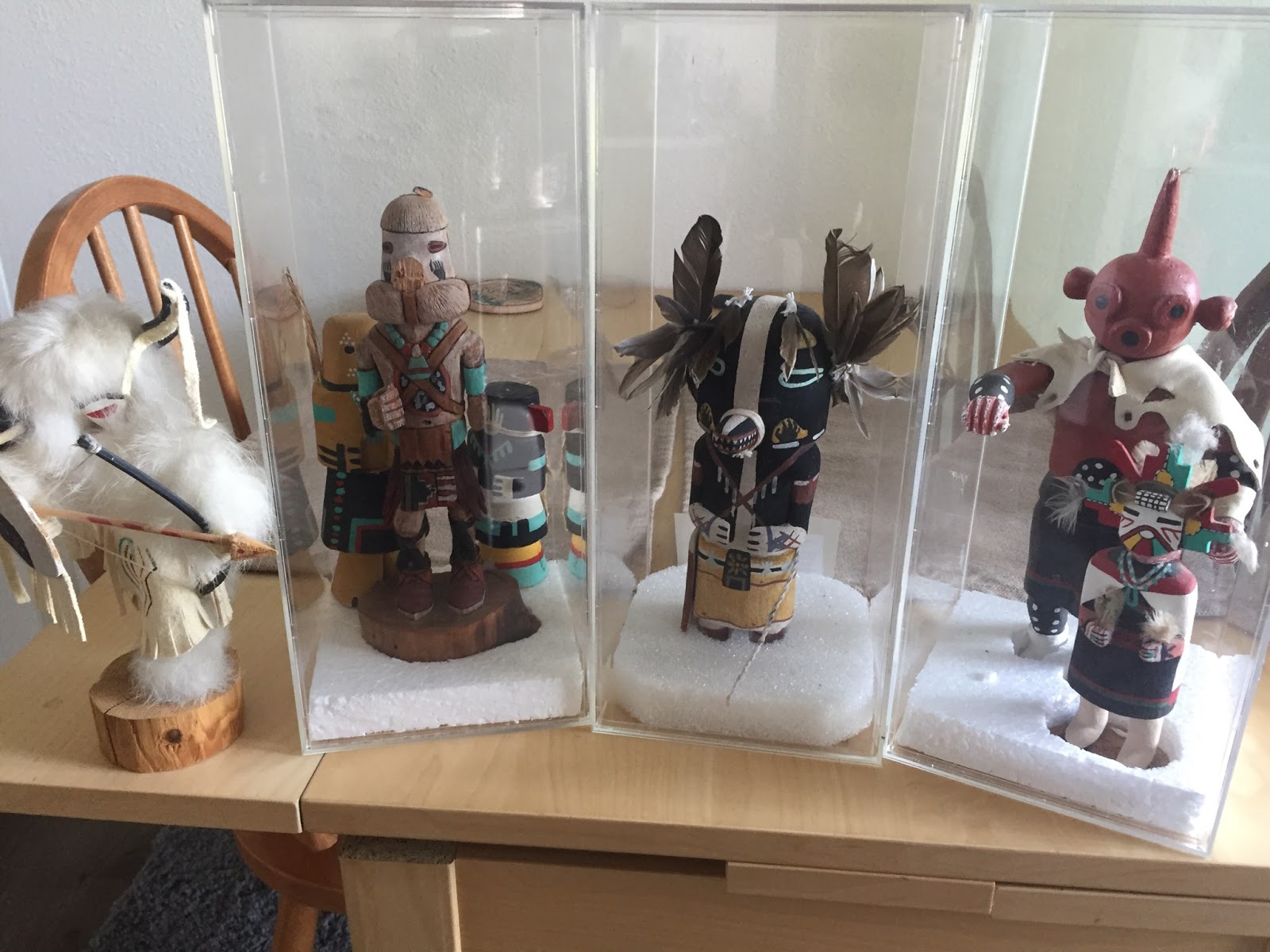
(Left to right: Apache Warrior Buffalo, two small in the first case are vintage Route 66 kachinas, large in the same case is a damaged Hopi Katsina made by Darin Masawytewa in 1994 that was rescued from the Goodwill store, the middle is a traditional Honan Katsina made by Brent Brokeshoulder, the large mudhead in the right is an older Hopi that is unsigned and the small one next to it is also a Hopi doll made by Leonard Shupla Sr.).

Katsina, or kachina dolls have been around for centuries and originally were a way to teach children about their ancestral and religious history amongst the spirits for Hopi cultures. The dolls are known to be the spirits, elements or animals whereas the dolls were crafted to represent a certain person, animal or deity for ceremonies. Over the past century, these pieces of art are quite popular among tourists and art collectors. During the popular times of Route 66, there were many buildings designed as Indian structures and knowledge of Indian cultures gained popularity as travelers went westward on Route 66. Many gas stations, restaurants, and other areas had shops that tourists could shop at. With the increased popularity of Indian arts and crafts, Route 66 Kachinas gained popularity. These, such as the two small examples in the left plastic holder, were small and didn’t have much detail as traditional kachinas. These were made quickly and cheaply to sell to tourists and they were quite popular in the 1940s into the 70s, or when Route 66 declined with the building of the interstate system. 

Afterward, more detailed kachina dolls were crafted by American Indians to make them look more authentic but were made from artists from different tribes than the Hopi. Traditional katsina dolls are made by the Hopi craftsmen and the art is traditionally passed down from generation to generation and the artists take pride in their work. Though popular amongst tourists and collectors, cheaper alternative kachinas are made by Indian artists from tribes such as the Apache. An example of these types of dolls, which are more detailed in a sense of more fur and attached details, is the white buffalo warrior on the far left. These are much cheaper than authentic Hopi dolls since the parts are typically premade and are glued together. These are still unique as each artist creates them differently and adds different features but are made much quicker which can create their price point cheaper. These types of kachina dolls are most commonly found throughout stores and collectors since they’re easier to find and have much lower price points. 

The more expensive ones that are harder to come by are the authentic Hopi katsinas. Only certain artists can make these and the bloodline of the artists go deep for many of the carvers. Examples of Hopi dolls are the three larger ones in each of the plastic holders and the smaller one in the right holder. If you notice the black doll in the middle, there is a string around the neck which is typical of a traditional Hopi doll since, after a ceremony, the dolls were meant to hang up on the wall. With over 200 types of kachina dolls, the Hopi dolls are made out of a single piece of cottonwood unlike the other types of kachinas which have attached parts. Authentic Hopi dolls are not only a single piece but are detailed in carvings and painted with care and pride. When shopping for a katsina or kachina, be aware not to spend a lot on a non-traditional Kachina. Even though they may look nice, a lot of sellers do not realize the difference and charge more than what they should. Both non-Hopi and Hopi dolls are signed on the bottom of the piece but a lot of the times, the non-Hopi dolls are illegible. Nonetheless, each is unique in their own way since they are handmade and are quite nice on display and each has a different meaning of such interesting cultures.

Thursday, March 19, 2020

Antique Chair Back to Life Restoration

I bought this chair recently on the clearance (25 cent) table at Habitat for Humanity and felt the need to rescue it and bring it back to life. 


I looked all over the chair to try to estimate a date but with the flat head screws and shapes of the screws that pre-date the 30s, my guess would be 20s to 30s? The first thing to do is to take the chair apart to get to its bare bones to start the restoration. The frame couldn’t be taken apart so I did what I could. Once disassembled, I sanded the old stain, or what remained of the former stain. The chair was discolored in many areas and very dry. It didn’t take much to get the old stain off the chair.


Once sanded, I cleaned the wood and then used a light stain to bring an original shade back to the chair. A few parts required an extra coat of stain. I kept the original cushion but cleaned it.  Had to use wood glue to attach a couple of broken pieces and one loose piece. I put the chair back together and it was stable and the stain brought back much luster to the char and I will be used in our house. From a 25 cent clearance table nearing the trash compactor to a useable and beautiful chair.


One unique characteristic was an unknown signature. Once I unscrewed the wood base for the seat, where two pieces of wood connected was a signature in blue ink. I made sure to keep the signature untouched and when screwing the chair back together, the signature is hidden for a future owner to come across.


Friday, March 13, 2020

Wasted Photography No More


Throughout my years of wherever I’ve been, there are many unique and interesting places that I’ve gone to and seen – especially in the West. Having lived in Arizona and Washington and spent time in Colorado, I’ve been to numerous ghost towns and areas that have been isolated or uncared for and forgotten about. Such areas have been fun to walk around and think about how life once was as well as to photograph the area. Letting the imagination wander as well as understanding history of the locations bring a perspective of feeling and connection.

Going back to my first blog, I love photography and taking pictures of old places such as ghost towns and abandoned, forgotten about areas and buildings. Photographing them helps preserve their stories and history – even if they’re in a dilapidated state and falling apart. Not everything lasts forever and back in the 19th century, many towns were started with the hopes of mining being ample enough to thrive. Not many towns survived. Ones that did had other resources to help such as Leadville and being a great city for the outdoorsman. Once mining dwindled, the town struggled until finding a new way to bring people in. Other towns were not so lucky or did not survive that long. Once there was no longer any resources for townspeople to make a living, people left. Look at Detroit the past couple of decades. So many people have left the once megacity to find jobs elsewhere. Not that Detroit will become a ghost town by any means, even though many neighborhoods and areas have, the city will find new ways to keep people there and bring in a new population. Others, such as the two largest ghost towns remaining in Arizona, Vulture and Ruby, people have left which left the buildings to fend for themselves over time. Sadly, since the towns lost their citizens, others have come in and vandalized property or stolen parts such as building roofs, doors, and so forth, which have weakened the buildings even more.

Moving beyond ghost towns and old buildings, I have thousands of photographs. What I hate worse is there are so many just sitting on my hard drive being wasted. Even though I’ve had them displayed and sold at a couple of coffee shops, I feel as if they’re being wasted on my computer. With that being said, I finally decided to put out photography collections of certain locations. The first one from the Abandoned series coming out at an unknown date but likely within the next two months, if that, will be of Leadville, Colorado. Leadville is an old gold and silver town featuring many mining camps throughout the area. Years have gone by as many buildings remain uncared for, the buildings were photographed throughout a few different visits and sadly since then, some of the buildings have completely fallen. Second of the series will be an Arizona ghost town so please be on the lookout for the Abandonment series, coming soon from Barnes and Noble!

Tuesday, February 11, 2020

Washington Roadside Attractions: Hat 'n' Boots

Roadside Attraction Edition:

Welcome to a new type of blog that I will include every so often. The blog will feature Washington roadside attractions. A little bit of an introduction is I enjoy the history of old, forgotten about historic areas as some of you already know which also includes old roadside attractions. Having lived in Florida, I did some research and visited some sites that were pre-Disney since when Disney World came in, most of the small attractions couldn’t compete and shut down. Not only do attractions close due to competition but also due to progress. Having moved to Washington State, the state has constantly been growing for many years and when more people come into an area, things change quickly and often drastically. With these blogs, I’ll share the information about some attractions that have survived but sadly, there aren’t many remaining. But, there are some neat and historic places that have survived progress and I hope will continue to remain as changes threaten older and more forgotten about sites and history. Roadside attractions can include anything that provides entertainment to a traveler, tourist, or anyone at all interested including old theme parks, unique architecture, historic sites, or even old restaurants and areas that have survived the threats of time.

Hat ‘n’ Boots:


Originally built in 1953 by Seattle artist, Lewis Nasmyth, the hat and boots were formally a part of a cowboy themed gas station. The gas station, opening the following year, was named “Premium Tex." It was built in south Seattle and the boots were used as the restroom for customers and those who stopped to see the large hat and boots. As time went on and Seattle was constantly busy, the owners and creators of Hat ‘n’ Boots, Buford and Bernice Seals, wanted to expand to make the area a small attraction called Frontier Village. He envisioned the area being a larger western theme tourist attraction to draw in more customers but was unsuccessful - primarily with I-5 being built in the 1960s and driving customers away from the area. Closing in 1988, the hat and boots fell into despair and vandalism as the area sat vacant until progress occurred. The area was going to become something else but luckily a local council raised enough money to not only move the iconic symbols but to also preserve them. The hat (44-feet wide) and boots (22-feet high) moved in 2003 to oxbow Park in Georgetown, just south of Seattle. The boots’ restoration was completed in 2005 and the hat 2010. During the opening credits to the original National Lampoon’s Vacation, a postcard of Hat ‘n’ Boots can be seen.

Address: 6427 Carleton Ave S, Seattle, WA 98108

Monday, February 3, 2020

Cellphones Are Not Allowed


If anyone has read any of my novels, most of them take place pre-1990s or even in the early 90s. Not often are there scenes from present times. I doubt many readers have noticed that but if so, there’s a one-word answer that explains why – cellphones. One thing I am not a big fan of is the ever-changing world of technology. Of course, some things are great but then again, some things are obsolete just as soon as they come out. Also, much of the world has changed so much and we’ve become overly dependent at times. So, when I write, I enjoy writing the times of pre-cellphones. Stories are so much easier to tell in a sense of having more options, especially with the antagonist in trouble, to not have the easy access to a cellphone to call for help. A great example of this type of situation is looking at sitcoms. What if Lucy was trapped in the freezer, or as I watch Seinfeld, the stories about nothing would not be there if the characters had access to cellphones. Television shows before the days of mass cellphone production had more options for storytelling and placing someone in a predicament or trouble. Just watch one episode of a sitcom from the early 1990s or earlier and at the end, think of how differently everything would have played out if the characters had cellphones. For example, in my latest novel, Soul Hunters – The Collectors of Fear (you can hear the first chapter read on my YouTube page – follow the link here: www.youtube.com/watch?v=NBwBkD7wutY&t=37s), the beginning of the story would be much different if the first two characters had access to a cellphone. With technology in mind, I predict most of my future novels won’t feature cellphones or even mention the name as well as the always changing technology but instead older/previous technology and times when life was simpler without being dependent so much on technology. Much like going to a movie at the theater – no cellphones!

Saturday, January 18, 2020

Mafia in Tucson and an Interesting Customer Interaction


So, as I lived in Tucson, Arizona for six or some odd years, I learned about the mafia presence in Tucson. Even though through the years, their presence has dwindled as the mafia of old, aged and retired into the mountains to enjoy a life of quiet and nice weather year-round. Crime boss Joe Bonanno resided in Tucson for many years and ran an empire but a few others, the rare Mafioso that survived violence, retired out to Tucson. I had heard of such tales and saw firsthand when I went to the Tucson Music Hall to watch the play, A Bronx Tale, featuring Chazz Palminteri. I stood on the second floor and looked at a group of a few older, overweight men dressed in suits and ties. What hair remained was slicked and their shoes recently polished. A couple of men nearby them looked around the theater entrance while the gentlemen spoke – pure-blooded Italian, they looked. A Bronx Tale, a play telling the tale of the mafia in New York was quite fitting. I wondered who they were and their background – if any. Possibly they were just there from harmless backgrounds. We must not judge one another but having studied the mafia and seeing numerous photographs, etc., I can only assume.

Having worked retail for fifteen years, I’ve met some interesting people. One incident happened as I was cashiering at the local grocery store Bashas’, up near Sabino Canyon. The area is quite nice and a lot of wealthier people live in that part of town. One night an elderly couple came through my line after I was called up to backup cashier. They were likely in their seventies and dressed very nicely. The woman’s hair was white and curled, dressed wearing real fur around her shoulders. As the man started talking to me, she stepped a few feet away to the side. The man had a thin stature with his thin white hair combed back. He wore a nice suit with tie and gold jewelry around his neck, wrists, and came to me with a thick Italian accent. Speaking with the man, his first words, not even a hello or proper greeting, was how easy it would be for him to kill me. Then, he said he could use a gun but that would be too loud. Or, he could use a knife but that would be too messy. He continued speaking that he could reach over and punch me in the neck or even strangle me which would be the best way. I continued ringing up his items, unknowing how serious he was but with the way he looked at me directly in my eyes, he looked serious. On the other hand, with his age, I figured that he wouldn’t. I thought that he was likely a retired mafia, or possibly not retired, reliving his younger days. Perhaps his mind was going and he was remembering ways he had killed before. I thanked him, not wanting to upset him during the awkward exchange, as his wife continued to stand quietly behind him. He gave a slight smile as he collected his bag, continuing to make eye contact. The smile was not a genuine smile of a gentleman, but one of a hidden past. I’ve always wondered who he was but I can only imagine, never truly feeling threatened, to know that he possibly could have killed me since he may have killed before.

Monday, December 30, 2019

Three Years of Adventure


(Vy and I at Changdeokgung Palace in South Korea)

Well, just recently Vy and I celebrated our three year anniversary. The past few years have gone by so fast but then again looking back, we’ve done so much. I love looking back at life through different times and seeing what was going on then and what changed. I think back before moving to Washington where I was struggling in Florida when I moved with my Uncle out back to Tucson. I love and miss the adventure out there and seeing ghost towns and historic areas but I made a change. I had met someone and she lived up in Washington and long story short, after a short time, I decided to take the chance of a lifetime to move states apart to the Pacific Northwest to a place I’ve never lived before. It was a challenge and I was very nervous – especially moving up here without a job. I remember the worries some people had about my move but I’m glad things have worked out. Things started falling in place when I got a job interview driving up to Washington and eventually got the job with Kellogg’s. Since then, Vy and I had gotten married and moved to our first apartment. The apartment was an old rundown apartment but we never had any problems the year we lived there. We’ve since moved to a different apartment for a year and a half and have recently gotten our first house a couple of months ago. It’s amazing the past three years thinking of the room I lived in for a little bit to us getting our own house and making it this far. It’s been quite the process but it’s nice to actually settle for the first time in a long time and have a place to call home. In the past few years, we’ve also gotten two new cars and traveled to different areas of the world. Besides Mexico and the Bahamas, I had never traveled outside of the country but the past three years, Vy and I have gone to Vietnam twice, Japan, South Korea, and even Canada. I love being able to travel and see many sights with Vy and even met her family in Vietnam and had fun getting to know all of them and learning many new cultures. I've learned so many things and tried foods I never thought I would try and some I liked but a lot I didn't. I liked shrimp head in Vietnam but not eel in Japan. There were many new foods, fruits and drinks and even got food poisoning twice from abroad. We’ve been on numerous hikes, road trips, and have created many memories. I can only hope our life together continues to be as fun and I can’t wait to see what comes up. I’ve had a new job since first coming up here and we’ll see what waits on the horizon for something new. I just look forward to new memories with Vy and enjoy every moment together. Happy Three Years to Vy and I look forward to every day with you!